
Arkansas death records serve as vital historical and legal documents that help families, researchers, and legal professionals verify identities, settle estates, and trace ancestry. These records span nearly two centuries and are managed through a combination of state agencies, county offices, and digital archives. Whether you’re searching for a recent death certificate or digging into 19th-century burial data, understanding how to locate and obtain Arkansas death records is essential. This page covers every official source, access rule, and practical step needed to find accurate, certified information quickly and legally.
What Are Arkansas Death Records?
Arkansas death records are official documents that confirm the date, place, and cause of death for individuals who died within the state. They include full names, birth dates, residence details, names of parents and spouses, attending physicians, funeral home information, and burial locations. Statewide registration began in 1914, but many earlier records exist through church registries, cemetery logs, newspaper obituaries, and county mortality reports. These records fall into two main categories: restricted (less than 50 years old) and public (50 years or older). Immediate family members, legal representatives, or individuals with court orders can access restricted records, while public records are open to anyone.
Arkansas Death Records Index (1812–2006): The State Archives Resource
The Arkansas Death Records Index covers entries from 1812 to 2006 and contains over 150,000 names compiled from church registers, cemetery ledgers, county mortality censuses, and 19th-century newspaper obituaries. Hosted by the Arkansas State Archives, this index—formerly known as the “In Remembrance Death Index”—links each entry directly to its original source location, whether a county clerk’s office, parish church archive, or state library microfilm collection. Researchers can cross-reference names, dates, and locations to pinpoint exact files without visiting every repository in person. This tool is especially valuable for genealogists tracing ancestors before 1914 when official state registration began.

How to Order Certified Death Certificates from the Arkansas Department of Health
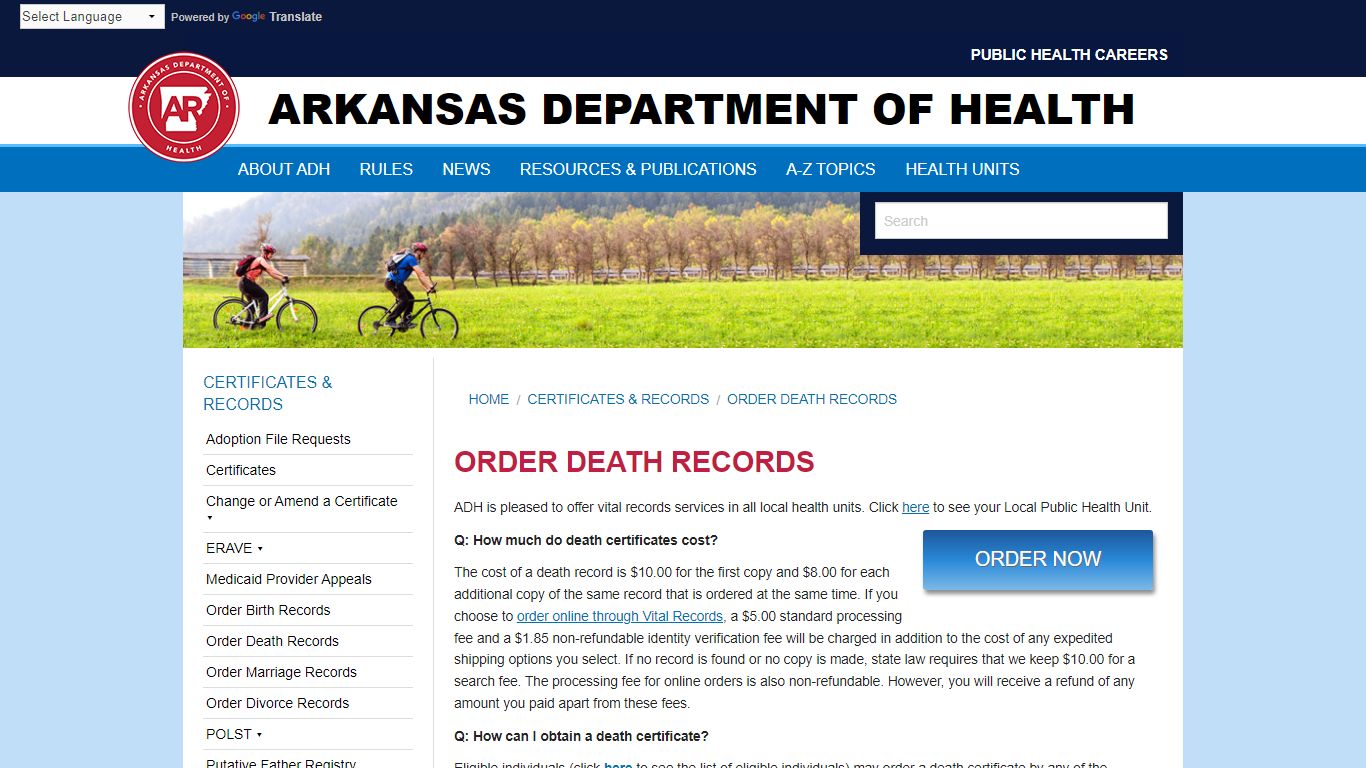
The Arkansas Department of Health’s Vital Records Division issues certified copies of death certificates for both recent and historic cases. Located at 4815 West Markham Street in Little Rock, the office processes standard requests within 10–14 business days and mails documents via USPS. Walk-in applicants must present a government-issued photo ID, complete a request form, and pay $12 for one copy or $25 for multiple copies of the same record. Out-of-state requesters need a notarized authorization letter and may pay an extra fee for expedited service. All applications must include the decedent’s full name, date of death, county of death, and relationship to the requester.
Public Access Rules: Who Can View Arkansas Death Records?
Arkansas law restricts access to death records less than 50 years old to protect privacy. Only immediate family members (spouse, parent, child, sibling), legal representatives with documentation, or individuals holding a valid court order may obtain these records. Records older than 50 years are considered public and accessible to anyone. The Freedom of Information Act outlines eligibility criteria and provides formal request templates available online or by mail. Each record includes the deceased’s full name, date and place of death, cause of death, and the informant’s relationship to the deceased. Researchers should always verify current rules before submitting requests.
County Offices: Local Sources for Arkansas Death Records
Each of Arkansas’s 75 counties maintains a local vital records office that stores death certificates filed within its jurisdiction. These offices work closely with the Arkansas Department of Health and contribute data to the National Death Index, enabling statewide searches. Residents can request records directly from county clerks, who often provide paper copies or digitized PDFs. Some counties, like Pulaski and Washington, now post indexed death records online with scanned images dating back to the 1920s. County offices also keep burial permits, coroner’s reports, and cemetery records, which help build complete genealogical profiles.
Official Arkansas.gov Portal for Death Certificates
The Arkansas.gov portal serves as a central hub for death certificate information, offering instructions for ordering copies, eligibility guidelines, and live chat support. Users can start conversations via web chat, email, or SMS to get instant answers about ID requirements, payment options, and processing times. The site links to a directory of local health departments that offer in-person help with certificate requests. Additional resources include a searchable FAQ database and downloadable forms that meet federal confidentiality standards. This portal simplifies access for both residents and out-of-state researchers.
Using FamilySearch to Locate Arkansas Death Records
FamilySearch provides free access to Arkansas death records through its wiki and digital catalog. Statewide registration began in 1914, but some city records from Little Rock and Fort Smith date back to 1881 and come from municipal health reports and local newspapers. Users should filter results by pre-1914 and post-1914 periods, with older records requiring manual review of microfilm at the Arkansas State Archives. The “Arkansas Death Index” on FamilySearch covers 1914–1969 and is searchable with a free account. This resource is ideal for genealogists seeking ancestors without traveling to Arkansas.
LDS Genealogy and Other Third-Party Databases
LDS Genealogy aggregates multiple Arkansas death record collections, including Statewide Death Records (1914–1950), the Arkansas Death Index (1914–1969) on Ancestry.com, and the Arkansas Death Certificates database (1935–1961). It also lists the MyHeritage Death Certificate Index (1935–1961) and the “Deaths and Burials” series from the Arkansas Department of Health for 1882–1929 and 1945–1963. Links to FamilySearch and Archives.com provide additional pathways to original certificates, probate files, and burial permits. These platforms expand research options beyond official state sources.
Online Search Portal for Death Certificates (1935–1961)
The Arkansas Department of Health operates an online portal that allows users to search and preview death certificates issued between 1935 and 1961. By entering a name, year of death, and county, researchers can view a scanned image of the original certificate, including cause of death, funeral home details, and physician signatures. After confirming the record, users complete a secure payment process and provide a mailing address for certified delivery. For records outside this range, the system redirects users to submit formal requests to the Vital Records Section, where extra verification may apply.
Vital Records Services at the Arkansas Department of Health
The Vital Records Division manages birth, marriage, and death certificates and maintains related statistical data for public health use. The office, located at 4815 West Markham Street in Little Rock, operates Monday through Friday from 8 a.m. to 4:30 p.m. and offers phone support at 1-800-462-0599. In addition to issuing certificates, the division provides disease surveillance reports, emergency response guidance, and aggregated mortality statistics for research. Families use these services for probate, insurance claims, and legal matters, while researchers rely on them for epidemiological studies.
Common Reasons People Request Arkansas Death Records
Individuals request Arkansas death records for many reasons. Family members need them to settle estates, claim life insurance, or update Social Security records. Lawyers use them in probate cases or to prove inheritance rights. Genealogists rely on them to build family trees and verify ancestral connections. Medical researchers study historical mortality patterns using public records. Journalists and historians reference them when writing about local events or notable figures. Regardless of purpose, accurate and timely access ensures these needs are met efficiently and legally.
Tips for Successful Record Searches
Start with the most recent source: the Arkansas Department of Health for deaths after 1914. For older records, use the State Archives index or county offices. Always double-check spelling variations, as names were often recorded phonetically. Include middle names or initials if known. Search by county if the exact date is uncertain. Use free platforms like FamilySearch before paying for services. Keep copies of all correspondence and receipts. If a record isn’t found, try alternate spellings or nearby counties where the person may have died.
Fees, Processing Times, and Payment Methods
Standard processing for death certificates takes 10–14 business days. Fees are $12 for one copy and $25 for multiple copies of the same record. Expedited service costs extra and is available for urgent legal or medical needs. Payments can be made by cash, check, money order, or credit card at the Little Rock office. Online and mail requests require checks or money orders payable to the Arkansas Department of Health. Always include a self-addressed stamped envelope for mail returns. Processing delays may occur during holidays or high-volume periods.
Legal Requirements for Requesting Restricted Records
To obtain a death record less than 50 years old, requesters must prove eligibility. Immediate family members must show a government-issued ID and documentation proving relationship, such as a birth or marriage certificate. Legal representatives need a notarized letter or court order. Others must obtain a judge’s approval. The Arkansas Department of Health verifies all documents before releasing restricted records. False claims can result in denial or legal action. Always prepare supporting paperwork in advance to avoid delays.
Historical Context: Evolution of Death Registration in Arkansas
Before 1914, Arkansas had no centralized system for recording deaths. Information came from churches, cemeteries, newspapers, and local officials. The 1914 law created the first statewide vital records system, but compliance was inconsistent until the 1940s. Early records are fragmented and stored in various locations, making the State Archives index invaluable. Over time, digitization efforts have improved access, especially for records from the 20th century. Today, both physical and digital options exist, but researchers must still navigate multiple sources for complete coverage.
Digital Access vs. Physical Archives: Pros and Cons
Digital records offer speed and convenience, allowing instant searches from home. However, not all records are digitized, especially those from rural counties or before 1930. Physical archives contain original documents with details often missing from summaries, such as handwritten notes or marginalia. Visiting in person allows closer inspection but requires travel and time. A balanced approach—using online tools first, then visiting archives if needed—works best for thorough research. Always verify digital findings with official sources when possible.
How the National Death Index Supports Arkansas Research
The National Death Index (NDI) is a centralized database managed by the CDC that includes death records from all 50 states, including Arkansas. Researchers can submit requests to confirm deaths across state lines or find records not available locally. The NDI requires detailed information and charges a fee per search. It’s particularly useful for verifying deaths of individuals who moved out of Arkansas or died in another state. Results include date, state, and certificate number, which can then be used to request full records from the appropriate jurisdiction.
Frequently Asked Questions About Arkansas Death Records
Can I get a death certificate for someone who died in Arkansas but lived elsewhere?
Yes. The place of death determines jurisdiction, not residence. If the person died in Arkansas, their death certificate is held by the Arkansas Department of Health, regardless of where they lived.
Are death records from the 1800s reliable?
Records from the 1800s vary in accuracy. Church and newspaper records may contain errors due to handwriting or transcription mistakes. Always cross-check with multiple sources when possible.
Do I need a lawyer to request a restricted death record?
Not always. Immediate family members can request records with proper ID and proof of relationship. Only those without direct ties need legal representation or a court order.
Can I search Arkansas death records for free?
Yes, through the State Archives index, FamilySearch, and some county websites. However, certified copies always require a fee.
What if the person’s name is misspelled on the record?
Request a correction by submitting a formal amendment form to the Vital Records Division along with supporting documents like a birth certificate or marriage license.
Are coroner’s reports included in death records?
Coroner’s reports are separate documents and not part of the standard death certificate. They may be obtained from county offices or the state medical examiner’s office, often with additional requirements.
How long does it take to receive a mailed death certificate?
After processing (10–14 days), mailing adds 3–5 business days within Arkansas and up to 10 days for out-of-state deliveries. Expedited shipping is available for an extra fee.
Contact Information and Official Resources
For certified death certificates or questions about eligibility, contact the Arkansas Department of Health, Vital Records Division, at 4815 West Markham Street, Little Rock, AR 72205. Phone: 1-800-462-0599. Office hours: Monday–Friday, 8 a.m. to 4:30 p.m. Central Time. Walk-ins are welcome, but appointments are recommended during peak seasons. All requests must include valid identification and completed forms available on the official website.
Official website: https://www.healthy.arkansas.gov/programs-services/topics/vital-records
Death Records Index: https://digitalheritage.arkansas.gov/death-records-index/
Online certificate search (1935–1961): https://www.ark.org/doh_dcs/
Arkansas.gov death certificate portal: https://directory.arkansas.gov/agency/department-of-health/service/death-certificates/